Showing posts with label Toyota. Show all posts

Thursday, July 9, 2020


General Motors, Decline and Fall,
1980 – 2009

William Sundwick

Founded in Flint, Michigan in 1908, the corporation that ushered in the automobile age in America and came to dominate the nation’s industrial economy by the 1970s, declared Chapter 11 bankruptcy just after celebrating its centennial.

What happened?

In 1980, journalist/folklorist Ed Cray published his history of that corporation, Chrome Colossus: General Motors and Its Times. GM then held a 46 per cent share of the domestic U.S. auto market. Cray notes it had been over 50 per cent in the early to mid-1960s, inviting threats of anti-trust action from Congress, amplifying anger at GM manufacturing decisions concerning safety and lethargic pursuit of emissions reduction. The Boards of Directors in those days were confident they could ride over these assaults. They were right -- so long as sales and employment were strong and stock valuation high. I certainly felt no insecurity growing up as a teenager in a Flint GM family!
But there was an unseen threat building, starting in the 1970s, which should have foretold a deepening challenge to GM’s place in the automotive market.

It came from Japan, with its much younger automobile industry looking toward export markets, not just in the U.S., but around the world. The first Toyotas and Datsuns appeared on the West Coast in the late 1950s. A curiosity at first with little penetration even in California. But that penetration grew and went nationwide by the mid-70s. GM management did recognize that there was something peculiarly competitive about Japanese manufacturing. They sought to learn more about it via partnership with Toyota. NUMMI (New United Motors Manufacturing, Inc.) was formed in the early ‘80s at a closed GM plant in Fremont, California (since sold to Tesla). It produced both Chevrolets and Toyotas side-by-side on the same assembly line.

But NUMMI failed to change “The General.” What General Motors couldn’t understand was that the secret of Japanese manufacturing, and growing preference of U.S. consumers, had nothing to do with efficiency of the machinery in the plant. It was not the “culture” of employees (the old GM workers were rehired in Fremont). Instead, it was mainly the culture of management. The Fremont plant was run differently from other GM assembly plants, following the Japanese model. But apparently, corporate management failed to notice a fundamentally different job design. Workers in Fremont rotated among many different jobs, rather than simply tightening the same bolt every day for an eight-hour shift on thousands of cars.

GM had advance warning of this problem from the wildcat strike at Lordstown, Ohio in the early ‘70s – where sabotage led to slowdowns and generally low production quality of the new “import killer” small car launched there, the Chevrolet Vega. Production rates were punishing, workers took it out on the product. Yet corporate management took no notice. After the “experiment” at NUMMI, Japanese style “relational management” never spread to other plants. The Vega’s design was considered flawed, too, not merely its manufacturing quality. General Motors could not see its employees as anything more than cost centers, whether hourly and salaried engineers. The public could see the effects.

“Corporate culture” has become a popular trope over the last thirty years. It probably had its origin in the sad story of General Motors’ decline. The corporation had its beginning in the early days of the automobile, in an environment analogous to how we thought of Silicon Valley in the 1980s. It was where entrepreneurial ventures based on engineering advances were the foundation of economic growth. Billy Durant, the founder of the corporation, was the embodiment of that entrepreneurial, risk-all, American myth that surrounded figures like Steve Jobs in later times. Durant’s genius (some would call it recklessness) was his willingness to take a chance on a bevy of garage tinkerers he met in Michigan. The first of them was Flint mechanic David Buick, struggling with his own version of a horseless carriage. His Buick automobile was the brand that started General Motors. Durant, however, did not build the GM corporate culture. The myth of that industrial spirit was, instead, created by Alfred P. Sloan. Sloan led an ever more centralizing corporate Board through the 1920s and 1930s. The stable of brands assembled by Durant and his early associates had all been managed independently at the engineering and production level. They always had shared technology and parts, but Sloan made them mere “divisions,” subservient to the General Motors Board of Directors, directed jointly from Detroit and Wall Street. Sloan was the archetype modern corporatist.


Sloan organized the corporation around profit centers and marketing concepts. Any original ideas for products or engineering had to clear rigorous financial hoops – the “bean counters.” The overwhelming strength of the industrial engine this strategy created caused General Motors to be perceived as a key factor for allied victory when World War II came. Its then-president, William S. Knudsen, became FDR’s head of the War Production Board.

But, after the war, that old, inherently conservative, midwestern corporate culture returned -- unable to focus its marketing on anything but the ego-enhancing product differentiation that Sloan had pioneered starting in the 1920s. The five automotive brands that GM successfully hawked during the postwar years (Chevrolet, Pontiac, Buick, Oldsmobile, and Cadillac) were distinguished mostly by size and flash – what would today be called “bling.” All were built on a similar platform with more engineering in common than unique. Chevrolets and Cadillacs were built during the period to be fundamentally the same, different enough only to make a convincing argument that the higher-priced brand was somehow “better.” This was, of course, illusion – manufacturing standards and quality control were identical at all GM plants.

GM corporate culture could not grasp the reason for the increasing success of Japanese imports through the 1970s and ‘80s. It was not their cars’ designs, but a combination of several factors. There was the above-mentioned relational style of management in plants (and with suppliers); the uncomfortable fact that legacy costs were low at the much younger Japanese firms (not as many retirees collecting pensions and benefits); and, yes, a less risk-averse product-planning style, greater willingness to take chances on new designs without the relentless bottom-line calculations, the Wall Street side, that dominated GM decision-making. It was the old company, Toyota the young company!

When the UAW chose to strike General Motors in 2007, the walkout lasted three days. But three days lost production was not enough to change GM’s ways. Market share in the U.S. by then was down to only 20 per cent, a far cry from thirty years earlier. The public had caught on, even if management had not. GM was a global enterprise, but European market share was declining as well, and China was just getting started. South American (primarily Brazilian) operations were significant, but not on the scale of North American or European. When Wall Street was hit by the 2008 crash, the General finally took off his stars and filed for Chapter 11 bankruptcy in 2009, the corporation’s 101st anniversary. Only a massive U.S. government bailout saved GM from liquidation.

Arising from the ashes, the “new” General Motors, General Motors Company, LLC, promised to be leaner and better – not necessarily meaner. But global market share, even after selling off subsidiaries, and shuttering brands (Hummer, Opel, Pontiac, Saab, Saturn, others), has not revived over the ensuing decade. By 2019, U.S. market share had eroded even further, to about 17 per cent. Had the General learned anything?

CEO Mary Barra has flirted with new products, especially electric vehicles, and claims the company will transition completely to EVs (well, 70 per cent by 2040), but we’ll see. The plug-in hybrid Chevy Volt was discontinued in 2019, with no replacement named. Lordstown, site of the painful wildcat strike decades earlier, was not reconfigured, but closed – then sold to a start-up who will manufacture all-electric pickup trucks there soon. Will the GM Cruise Division, formed to manufacture autonomous vehicles at its Hamtramck plant, ever see the light of day?

If I were a prudent investor, I would not buy GM stock.


Saturday, July 6, 2019


Pittsburgh

Nice to See Yinz Agin’

William Sundwick

Pittsburgh used to feel so familiar. Countless trips from the time I first met my wife, a native of McKeesport in southeastern Allegheny County. Then, after her mother died, and father moved to Florida, the trips stopped. But when both our kids went to school in the ‘burgh, nine consecutive years ensued of schlepping around Oakland, Squirrel Hill and Shadyside. One went to Carnegie Mellon four years, then his brother to Pitt for five years. The city became very familiar.

After the Pitt School of Education Masters ceremony in 2012, however, there were no longer kids there. We visited again in 2014, anticipating a final goodbye to the city.  That visit came as we circled home from our great midwestern road trip to Michigan and Chicago. We stayed at the Priory, enjoyed cocktails on its veranda, walked to a game at PNC Park, and across the Andy Warhol bridge to his museum.

It would have made a spectacular adieu to the city of rivers.

Five years later, though, another opportunity arose. My wife, the Pittsburgh native, had a milestone birthday! For my 70th  she had treated me to a Baltimore overnight, exploring parts of Charm City I had never seen. Now, it was my turn to reciprocate.

In addition to the celebratory occasion of my wife’s birthday, this would also likely be the last road trip for our old reliable 2007 Toyota Highlander. The old girl continued to impress us with her stamina, after 88,000 miles, but was due for replacement – probably sooner than our next ambitious  
highway trip. The car had performed yeoman’s service on the much longer 2014 trip, but she was five years younger, then. Her maintenance schedule had been (fairly) religiously followed since, and I was confident she could make it.

I even had the car washed, the “Manager’s Special” at my local car wash. She was cleaner than I’d seen her for years! Her metallic grey/green finish glistened in the sunlight (my wife always hated that color – we had bought the car used off a dealer’s lot). Tire pressure checked out. We were ready to go.

I can only hope that some future worthy owner, who relies on the vehicle for livelihood and family, will cherish her as much as we have,  for at least a little longer (we plan to donate the car to “Vehicles for Change,” as we have the last two cars we’ve replaced).

Our destination was a historic downtown hotel, the 103-year-old Omni William Penn. Historic hotels are a thing with us on vacations – we’ve stayed at the Palmer House in Chicago (in 2014) and the Omni Grove Park Inn in Asheville (2008) on previous excursions. We like the gilded age elegance evoked by these grande dame hotels. Our “Deluxe Suite” at the William Penn was no exception. A massive sitting room was even larger than the bedroom. It was located on the sixth floor, the next floor down was, mysteriously, the fourth floor. We never asked about the missing fifth floor.


The hotel lies directly across the street from Mellon Square, a picturesque be-fountained park on multiple terraced levels. Market Square is also nearby with its live music and vendor stalls. But downtown doesn’t have quite the panache of the cultural district or Oakland to the northeast, or Squirrel Hill with its dignified air of Pittsburgh urban upper middle class. Those neighborhoods had become our stomping grounds a decade earlier during the college years. The hotel was an easy walk
across Roberto Clemente Bridge to PNC Park for the baseball game on Sunday against the San Diego Padres.

First, however, we did take the car out of the garage for our Saturday night dinner reservations in Mt. Washington. LeMont restaurant is noted for its view of the Point, where the Allegheny and Monongahela Rivers meet. Our table, by a large picture window, provided ample photo ops. But, for us amateur photographers, the restaurant is just three doors down from the Duquesne Incline, an even better photo op of the same scene. The food was good, but not extraordinary like the view. We both had fillet mignon and a California merlot.

The Pittsburgh Parking Authority mandates all garages charge the same rate, $6/day on weekends. Hence, we paid $6 when we took the car out to go to dinner, and another $6 the next day when we left for home. $12 total for a full weekend in downtown Pittsburgh seems like a parking bargain to me. We had to pay $10 for just two hours in a lot at Mt. Washington.

We indulged ourselves Sunday morning at the hotel’s “breakfast buffet,” an all-you-can eat orgy containing everything on their menu. We ate too much. My FitBit calorie count was inestimable, but I took a guess at somewhere in the 800-calorie range. I don’t eat out much. The Bob Evans in Breezewood on Saturday was kind enough (ha!) to provide calories on its lunch menu. I hate that.
It was a very warm – and sunny – Sunday for the game. Dressing lightly was certainly appropriate, but uncovered seats presented a new problem, not encountered by me before. Wife was cautious enough to pack sunscreen, but she never spends time outdoors. I was well-acquainted with walking year-round, and yard work into the summer. I could tough it out. Wrong. Sitting in one place for the duration of a long (very slow moving, it turned out) baseball game – fully exposed to the sun – leads to sunburn! 

It’s not like moving around or walking. I’ve never been a beach person, so didn’t know this. I’m still recovering two weeks later.

Ultimately, it was an exciting game – Pirates came back from a three-run deficit in the ninth to send it into extra innings. Then, again, in the 11th inning, not only overcame another three-run deficit, but walked in the game-winning run. Fireworks, as always, when home team wins!

The four-hour drive home to Virginia was relatively painless at night. Traffic was light and we had no problem alternating driving stretches in the same manner we had done during the many daylight trips we made over the that Parkway (376) –> Turnpike (76) –> I-70 –> I-270 –> Beltway (495) route as always. The birthday weekend in the ‘burgh had come to an end. We showered, ate midnight snacks and watched a pre-recorded half-hour sitcom from our DVR. Then to bed. Next morning, wife got herself to work for another week. I felt like I had given her something, then proceeded into my Monday routines of breakfast, doing my laundry, going for a walk -- before it got too hot – then the gym. And, so it goes.


Thursday, May 9, 2019


Next Step in Car Shopping

Advance to the Test Drive?

William Sundwick

This year’s Washington Auto Show was in April. Held later than last year, it began to push into 2020 model year marketing territory. Nevertheless, it provided a useful opportunity to further explore the 15 vehicles that had found a place in my Crossover Shopping spreadsheet for 2019. They were all there, under one big roof at the Walter Washington Convention Center.

Indeed, planning our Friday evening outing to the show forced a decision: which stands to visit among the 15 contestants? My boredom with the process, after three years, made it easy to cancel two manufacturers from our schedule, and my wife readily agreed; we wouldn’t bother with Hyundai or Mitsubishi.

That still left a heavy burden of covering seven other stands on two floors in less than four hours before the show closed at 10:00 P.M. (We literally forgot one important display, Nissan, despite our intentions).

What we learned from this year’s show allowed us to reduce our 15 original entrants to five finalists. Each of the five comes from a different manufacturer, so advancing to the test drive, step four of my systematic process of shopping for a new car, would require some time – visiting five different dealerships.

First, the eliminations from the original list of 15 – Hyundai primarily because the Santa Fe, although new for 2019, struggles to match competitors’ fuel economy ratings, and has nothing else to set it apart from them. Mitsubishi, I feel, is still a questionable investment for the future, with reviews panning its quality and reliability. Beyond those two makes, which didn’t even warrant our attention at the show, those we saw also allowed us to eliminate more.

Scratch everything from GM – Buick, Chevrolet, and GMC – mostly due to brand image for Buick and GMC (my wife is sensitive to what sits in our driveway, no trucks, no stodgy Buick), and size/style for the Chevy Equinox (it squeaks in on the low end of my threshold for cargo volume).

Going for style is probably shallow in a new car purchase, but two eliminations were primarily due to styling. Both the Equinox and new Toyota RAV4 were, in comparison to competitors, well … ugly! The Equinox’s bustled rear quarter combined with squarish roof line just rubbed me the wrong way, reminding me of a pop-up camper. And, the RAV4, while entirely new from last year, looks like (wait for it!) a Toyota. The previous generation RAV4 had a
pleasant appearance much like its hot-selling competitors, not so this new version. Often, over the years, Toyota styling has been disturbing, very angular, depending more than others on frivolous details and faux-aggressiveness – the new RAV4 fits that unfortunate mold perfectly. It also seemed to have a cheaper interior, practical perhaps, but lacking the upscale feel of many competitors.

I also had no problem eliminating some of the larger contenders. After seeing them at the show, both my wife and I decided we could do without the Ford Edge or Subaru Outback. Yes, they’re bigger than the Escape and Forester, respectively, but the Edge is significantly more expensive than the Escape for that extra room, and Outback comes in a bigger package than Forester, but with virtually the same cargo volume!


VW’s models went in the other direction. The eliminated entrant was the smaller Golf AllTrack wagon -- like Equinox, possibly too small. And, it’s certain to be discontinued (along with all Golf wagons) for 2020. Besides, the larger Tiguan seems to sell for about the same price.

Due to my inadvertent snub of Nissan, and difficulty in eliminating something I didn’t see, the five finalists have now become:
  •        Ford Escape (carry over for 2019, all new next year)
  •          Honda CR-V (solid contender, as always) 
  •          Nissan Rogue (can’t eliminate, although nothing exceptional save Hybrid fuel economy)
  •          Subaru Forester (very impressive new body, almost indistinguishable from last year – “don’t mess with success”)
  •          Volkswagen Tiguan (cars were locked in display! But, peering
    through windows and looking at stickers resulted in a thumbs-up)

Stickers on all five finalists are in the same ball park for comparably equipped models. But the Auto Show cannot convey any sense of drivability. Performance, handling, visibility can only be judged after a test drive at a dealership. These days, the usability of electronics, infotainment systems, safety features also can only be explored in a test drive.

Therefore, the test drive is the next step. It won’t happen until after the June visit of in-laws from California, however. My wife must be fully involved, and she is now concerned primarily with her sister and brother-in-law’s visit. Maybe we’ll take them along?

If it waits too late into the summer, we may be pushing up against the 2020 model year – resetting the cycle back to spreadsheet updates and research. There are multiple dealerships in Northern Virginia we might visit. For close-in Arlington, Falls Church, and Alexandria there is Koons, Jerry’s, and Ourisman Ford; Bill Page, Brown, and Landmark Honda; Passport Nissan; Beyer Subaru; and Alexandria VW. Tysons contributes Priority Nissan, Stohlman Subaru and VW. If we choose Fairfax or Springfield, we can hit Sheehy or Ted Britt Ford, Brown or Priority Nissan, Farrish or Sheehy Subaru, and Fairfax or Sheehy VW.


It’s not likely that we’ll need to drive more than one version of each of the five finalists – we’re not looking for any unusual combination of equipment, except possibly a Hybrid Rogue. So, choosing a map direction and hitting all the dealers in that vicinity might work. But it likely would require more than one afternoon, we could go twice or three times.

Is there an easier way to make our decision? The drive is the thing, it seems. Choices of color and equipment are reasonably uniform among all. Both my wife and I will be drivers, and both of us will be passengers. There will be one or two car seats in the rear. The driver will evaluate instrumentation, performance and handling, while the passenger evaluates electronics, general comfort, climate controls, and interior detailing. Only a test drive can afford this opportunity.

Since we intend to keep this car for more than ten years – as has been our habit for the last thirty years -- the answer to the question, “is there an easier way?” is emphatically no!


Thursday, May 2, 2019


What Makes People Buy That Car?

Marketing Trends in the Auto Industry, a Photo Essay

William Sundwick

They were called “horseless carriages” for a reason. The earliest automobiles had open bodies fashioned from wood, sometimes with a folding top, like popular carriage designs of the time.

Soon, however, there emerged more luxurious closed bodies, often only the passenger cabin, with the driver still exposed to the elements. But these “cabs” were generally considered to occupy only the top end of the market, or livery vehicles.

The Model T Ford then created a “mass market” for automobiles in the United States. But roughly by the end of the First World War, closed bodies became more commonplace – even for the Model T. Ford had competitors by this time, many makes were marketed to less than upper-class buyers. And, as the maturing auto industry moved through the 1920s, there seemed to be a stock selection of body styles. There were coupes (with or without jump seats in the rear), sedans (two or four doors, but with full back seat), town cars and limousines for the chauffeur-driven elite (passenger
compartments separated from driver by full glass partition), and roadsters (no back seat, except possible “rumble seat”) or phaetons for the “open air” crowd (old style “touring” bodies with four doors and spacious rear seat).

These different body types appealed to folks now driving longer distances, often between cities. Both comfort and reliability became the most common marketing pitches for all auto-makers. In the U.S., General Motors, Chrysler Corporation, Nash, Hudson,
Studebaker and Packard all laid claim to significant portions of the market in the ‘20s and ‘30s. (Ford, the originator of the market, was overtaken in market share by both GM and Chrysler by the time World War II began).

Closed bodies (coupes and sedans) dominated the market from the onset of the Great Depression in 1930. Comfort and quiet, along with new features like radios, heaters, and window cranks made the passenger cabin a much more parlor-like experience, even in the popular-price segment where Chevrolet and Plymouth became the new market leaders.

Styling of auto bodies underwent some drastic changes in the 1930s. It was not just the enclosed quiet of the cabin that characterized cars of that decade, but major marketing initiatives around
“streamlining” and appearance of speed (if not reality) pitched by all manufacturers as a desirable look of the future. As always, the future was more appealing to younger buyers. And, younger buyers were coming in greater numbers as we approached entry into World War II. The most extreme futuristic streamlining, like Chrysler’s “Airflow” design of 1934, seemed avant-garde by the standards of the time.


Through the decade, running boards gradually disappeared from all cars, pontoon fenders with fared-in headlights became the norm, smooth curves replaced boxy shapes in all body styles. Horsepower ratings also began to be advertised during the 1930s and became a major marketing strategy after the war.

Tasteful, curvy streamlining and pontoon fenders began to fade post-war, as a brash new generation of designers took over in Detroit. GM’s Harley Earl (the dean of that earlier generation of stylists) retired, and people like
Raymond Loewy (Studebaker fame) took his place.

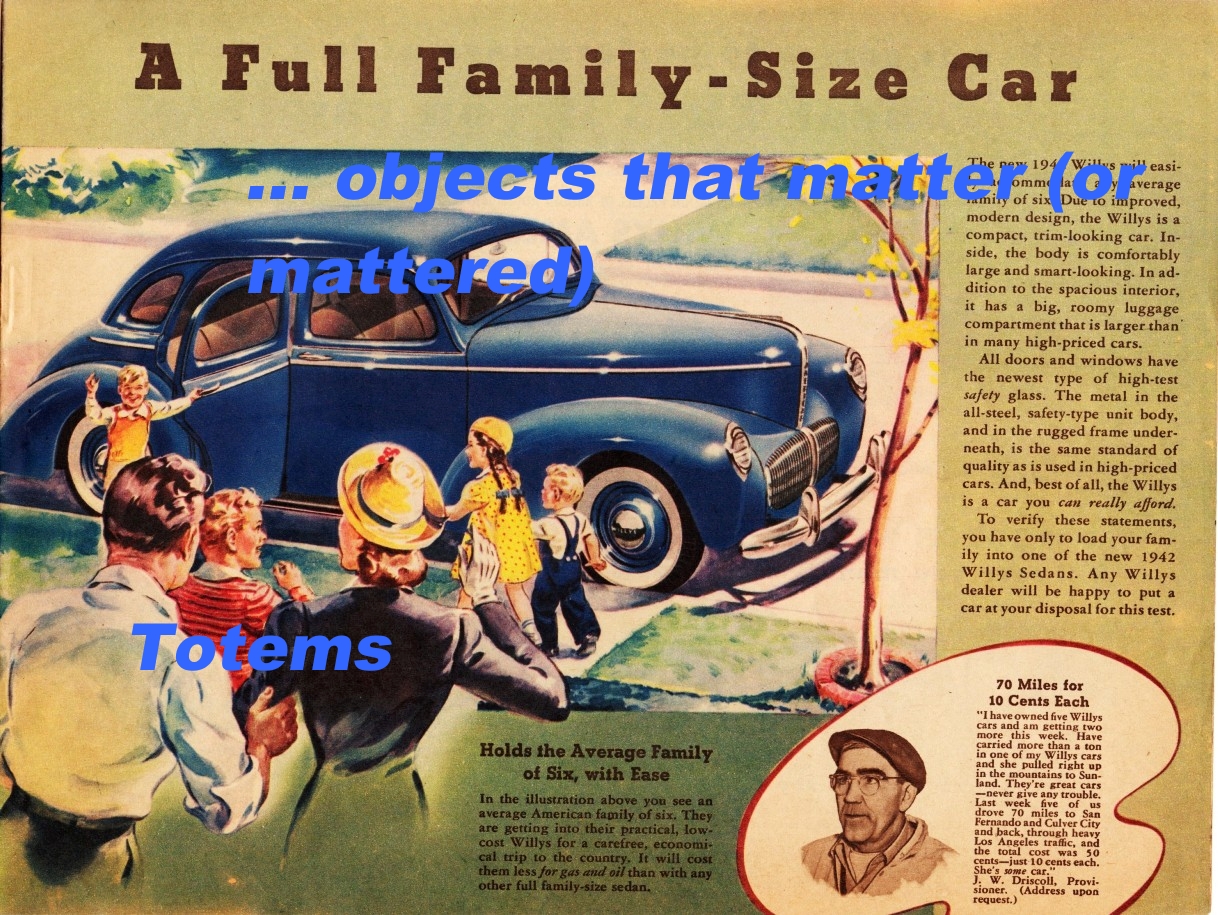
While a spacious, comfortable cabins continued to be important to the post-war auto buyer, new demands from the growing popularity of family vacations by car took on more importance. Trunks had to accommodate ever more luggage – not to mention golf clubs! This, in turn, caused another aesthetic shift in the appearance of auto bodies. Long hoods (to accommodate powerful V8 engines) were supplemented by long trunks. Cars got very large. The cabin area, now diminished as a percentage of the overall length, was made to seem bigger by much more glass. Wrap-around windshields and rear windows. The literal disappearance of side window frames (when
lowered) made the “hardtop” body style (two or four door) the most popular configuration in the ‘50s and ‘60s.

Perhaps unsurprisingly, there was a reaction to the apparent excess of the huge cars, powerful engines, and lots of chrome. Beginning even before the war, a niche market for imported small cars (usually from Britain, like Austin, Morris, MG) started to develop, especially in coastal cities. By the early ‘50s, this market had grown enough that many British automakers were equipping their export
vehicles with left-hand drive, aimed specifically at the U.S. and Canadian markets.


While the price of gasoline was never a constraint in the U.S., as it was for the native designers in Europe (not to mention their narrower urban streetscapes), the general cultural reaction against bigness and flashiness grew to such an extent that Detroit had to respond. But, since product development cycles in the auto industry are attenuated over several years, the new Detroit “compacts” didn’t arrive until 1960. By that time, Volkswagen Beetles had become a common sight in most of America. Rambler led the way somewhat earlier and could show a growing market share in the mid-to-late ‘50s as proof.

Keeping up with changing tastes of a young, more suburban, market in the fifties and sixties led to some important trends. Two body types that grew into an impressive social mainstay were convertibles and station wagons. Both body styles imbued a certain social status to their owners – convertibles implied youth, daring,
and enough affluence to have one car (of two) dedicated more to fun than practicality. Wagons frequently had three rows of seating,
for growing numbers of kids, not necessarily your own, but the neighbors’! For a while, it was thought that kids enjoyed facing the rear window in that third-row seat, although some safety concerns were later raised about that configuration. Even without the third row, wagons were great cargo carriers -- virtual car-truck hybrids! They were great for suburban shopping and family vacations, able to accommodate long things, like surfboards or plywood paneling for the basement.

Automobile marketing became more mysterious, at least in the eyes of this observer, in the 1970s.  Convertibles began to disappear – supposedly killed off by the insurance industry. And, while big cars with big engines continued to dominate Detroit, small imports retained a large following. What is strange, both for the domestic bodies and imported offerings, is the popularity of two-door models. For some reason, and I’ve been unable to find a psychological study explaining it, two-door bodies
across all segments of the market, outsold four-door bodies. Why? What possible advantage would buyers of that era see in having only two doors? Ingress and egress to the rear seat was harder. But even large cars with much rear seat leg and hip room, seemed to have popular two-door variants. Many of the two-door cars had tiny rear quarter windows, giving rear seat passengers privacy, perhaps, but decreasing visibility for driver. It seemed a perverse design trend, and it continued into the 1980s.
The coming of the BMW (and others, both foreign and domestic) four-door sport sedans in the ‘90s effectively killed that mystery market for two-door cars. There was no longer any connection
between “sportiness” and having only two doors.

Of course, throughout the history of the automobile, there have been many smaller niche markets: electric cars in the teens, sports cars from the 1920s on, drag racing wannabes in the muscle car era of the ‘60s and early ‘70s, and early 4x4s (Jeeps and pickups). Trucks moved from a rural niche market for private transportation into the mainstream with the coming of the smaller Japanese pickups in the 1980s.


The original Jeep was the first SUV. But Toyota, Nissan, then GM, Ford, and Chrysler all discovered
these truck-based wagons. The Chevy Suburban had been around since before the war but was relegated to one of those niche markets until suddenly, in the mid-70s, competition blossomed. Jeep Cherokees, Chevy Blazers, Ford Broncos, Toyota 4-Runners and Nissan Pathfinders all roared into the 1980s as the new best sellers.

 They were, indeed, trucks. They were all built on a pickup frame, with a body (two-door at first, later expanded to four doors) that
included a bouncy, but roomy, rear seat.

As trucks developed their own market segment, complete with luxo-cruisers, monster off-road vehicles, and compacts for urban living, it occurred to the intrepid auto designers that a true car-truck hybrid might fuse the enthusiasm of the SUV buyer with the family buyer who had previously settled for a matronly minivan. The “crossover” was thus born.

2018 Buick Enclave
2018 Honda CR-V
Crossovers emerged in a variety of form factors, from large three-row quasi-minivans (Buick Enclave, Toyota Highlander, Honda Pilot), to compact two-row versions (Toyota RAV-4, Honda CR-V, Subaru Forester), to sub-compact little cars (Fiat 500X, Honda HR-V, Ford EcoSport). Compact crossovers are now the hottest selling market segment of all, with larger and smaller versions close
behind.
2019 Ford EcoSport

It seems that a combination of a “high ride” (you look down on traffic) and the practicality of a large open cargo area (accommodates bulky items) are the main selling points. The main distinction between a crossover and an SUV is that the crossover always has a unitized body-frame, like other car bodies, but unlike the separate platform frame of truck-based SUVs. Hence, the ride is more car-like.

This is where we have come after more than 100 years of automotive market segmentation and design whims. Practicality combined with comfort and freedom have always ruled the marketplace. Of course, my unsupported impressions are subject to dispute. I’ve always been partial to the Harley Earl period at General Motors, myself!