


dealing with the Present, the Past, the Future ... and other things that matter
Subscribe To

 Posts
All Comments
Posts
All Comments
Tuesday, January 23, 2018

Tuesday, January 9, 2018

Speed Culture: Why?
William Sundwick
Origins of Speed
In the earliest days of the automobile, the “horseless
carriage” era, all cars were mechanical curiosities. They were playthings for
the rich and adventurous. None were particularly reliable, but many startups sought
to sell something new and different to a privileged few.
When the Model T became a true mass market phenomenon by the
1920s, a consolidation began in the auto industry. Soon, there were far fewer
choices in a price range that many people could afford. Mechanical reliability
became the norm. As the number of choices for affordable, reliable transportation
diminished, and sales, especially of the “T,” continued to grow, a large supply
of spare parts, easy to fabricate, entered the market. Another big thing
characterizing the 1920s in America was Prohibition. It created an
unanticipated new market for bootleggers
to build cars that could outrun the police on country roads, an “outlaw”
market.
 Then, the Depression
hit. Prohibition was repealed, but the popular glamorization of the
bootlegger’s “souped up jobs,” modifications to older low-priced Fords or
Chevrolets (since nobody could afford new ones) created a fad among a certain
set of young men, in California at first. Ford added fuel to the fire by
introducing a daring new design in 1932 – a V8 engine that would sell in the
same price
Then, the Depression
hit. Prohibition was repealed, but the popular glamorization of the
bootlegger’s “souped up jobs,” modifications to older low-priced Fords or
Chevrolets (since nobody could afford new ones) created a fad among a certain
set of young men, in California at first. Ford added fuel to the fire by
introducing a daring new design in 1932 – a V8 engine that would sell in the
same price
The “after-market” in
parts for Model T and Model A four-cylinder engines was already established.
Some of those same shops easily shifted to V8 “speed parts.” Better still for
the new racing hobby, Model T and A chassis’ could easily accommodate the V8.
Bingo – “hot rods” were
born!

NHRA Solves Social Problem
As hot rod top speeds approached 100 mph, public outcry grew
louder about safety. The typical American disdain for idle young men
(unemployed, under-educated, easy targets for gang recruitment) played a role. Street
racing became a social problem. Finally, in 1951, the National
Hot Rod Association was formed, founded by Wally Parks,
and set about opening officially sanctioned and regulated “dragstrips” around
the country, often on abandoned airfields disused since the end of World War
II. Returning veterans added respectability to the hobby, many having gained
mechanics’ skills during their service. With the help of the NHRA, drag racing
became professional.
Early dry lakes
racing had been organized and officiated by the Southern California Timing
Association, and the standard ¼ mile straight line course (1320 ft.) was
established by them. The NHRA, however, invented the “Christmas tree” light
system to control staging between two

Detroit Discovers Speed
Cued to the popularity of the “speed culture,” Detroit
continued development of mass-produced V8 engines from the late ‘40s on. In the
1950s, America was becoming an automobile obsessed country – especially for
young, new drivers. The growth of suburbia and improving highway infrastructure
also facilitated a motorized transformation of society, everywhere except in
central urban cores.
 In 1955, Chevrolet
introduced its “small
block” V8, soon eclipsing the old flathead Fords in everybody’s hot rods – it
outperformed even the most “souped up” Fords due to its efficient
In 1955, Chevrolet
introduced its “small
block” V8, soon eclipsing the old flathead Fords in everybody’s hot rods – it
outperformed even the most “souped up” Fords due to its efficient
By 1958, the NHRA had begun racing its “stock” classes and
“super stock” classes (the latter were factory produced high performance cars
sold in limited numbers through ordinary Chevrolet, Ford, or Dodge dealers).
This created what was known at the time as a “horsepower race” among the
Detroit manufacturers – they were competing among themselves for the highest possible
SAE (Society of Automotive Engineers) horsepower rating of their production
engines, presumably as a spur to greater sales. All these engines were large
displacement V8s. Indeed, volumetric dimensions of the eight combustion
chambers were probably the main determinant of horsepower rating in those days.
Other design features
like multiple carburetors, higher compression ratio, intake and exhaust
manifold shape, were relatively minor contributors to raw power.
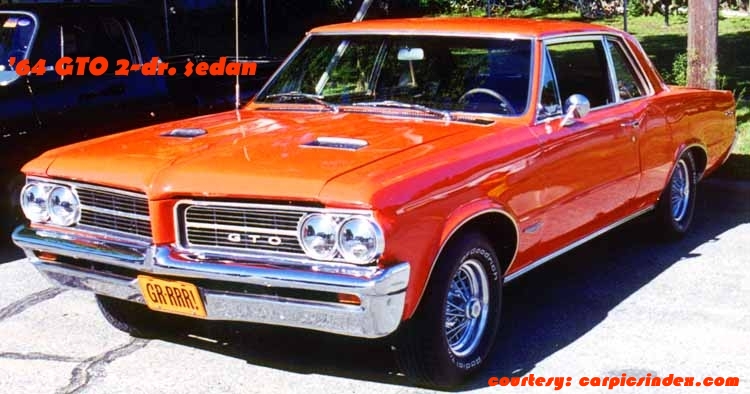
Soon, a new breed of
“stock” automobile emerged from Detroit – the “muscle
car.” This took the existing engine
design technology (basically, bigger displacement) and placed it in a lighter
body. The
Speed Dies and is Reborn
Then came the 1970s. First it was the Feds – new emissions
requirements forced on Detroit automakers (and imports) effectively strangled
the horsepower output of all engines beginning about 1971. Although not
connected to the new emissions requirements, manufacturers agreed to use SAE
“net” horsepower ratings rather than “gross.” This measured engine output
through the exhaust system rather than at the flywheel. The alleged “high
performance” offerings from all domestic makers lost up to 100 hp overnight! Since
1972, only SAE net ratings have been advertised. As the ‘70s continued, foreign
policy also had a big effect on the auto market in the United States. There
were two successive “oil shocks” – in 1973 following the Yom Kippur War, and
again in 1980, following the Iranian revolution. American dependence on Mideast
oil became painful to all – but, none more than the high- performance
enthusiast. The third blow to the speed culture was the insurance industry. In
the mid-seventies, they collaborated in raising rates for what they deemed
“high performance” cars. These situations made it uneconomic (in the case of
emissions, illegal) to do anything meaningful about boosting performance of
your daily driver, and Detroit followed suit. Muscle cars died a slow and agonizing
death. The “GTO” badge, for example, became trim only, divorced from engine
choice, and disappeared completely by 1975.
Unforeseen at the time, however, the whole world of
performance – yes, horsepower --- would rise again from the ashes, like a phoenix.
Starting in the nineties, and continuing today, new technologies built around
digital EEPROM Engine
Control Units (ECUs), fuel injection, turbochargers
or superchargers, cheaper gas, and much safer cars (thanks to those Feds!)
have all contributed to a renaissance. And, not least, a new class of young
drivers, including recent immigrants, who embody some of the same
socio-economic characteristics as those depression-era California dry lakes
racers. They may be idle, without much formal education, but gifted with a
spirit of competition and a cult of ingenuity. They’re more likely to choose
small imports nowadays, rather than “Detroit iron,” but the impetus seems to be
the same.
What is that impetus? Cars are both economic necessity and
ego extension (Freudians might call them phallic symbols). They express desire
for social
status, despite lack of financial resources. Also, that natural thrill of
competition, and creativity through mechanical ingenuity, all contribute to the
“speed culture.”
Drag racing has become international. In
Australia, it’s almost on equal footing with the U.S. Sweden, Finland, and the
U.K. also have active groups with organizing associations. There is a vigorous
after-market in bolt-on turbochargers and superchargers, and compatible replacement
ECUs with programming kits.
Not to miss an opportunity, Detroit has once again jumped
into the fray. What’s with the 2018 Dodge
Challenger SRT Demon? The newly introduced factory drag machine from FCA
(Fiat Chrysler Automobiles) loads a race built 6.2-liter Chrysler hemi V8, with
supercharger, rated at 840 hp (SAE net)! Far removed from the 300 or so horsepower
(SAE gross) of the 1950s super stocks. The car is “street legal,” which means
that it can legally be driven to and from the dragstrip -- much like those
early dry lakes hot rods. But, its real purpose is to win drag races. It is
clearly optimized for ¼ mile acceleration. As such, it is touted as the fastest
production car ever manufactured by a volume auto-maker. Under ten seconds for
that quarter-mile run, accelerates 0-60 mph in 2.3 seconds, exerting a force on
driver of 1.8g. Something like NASA!
And, you can buy it
for a mere $86,000 right off the floor of your local Dodge dealer (still ~$6000
less than a standard 370 hp Porsche
911). FCA plans to make 3000 of them. Why? Because it thinks it can sell
that many!

Tuesday, January 2, 2018

Tuesday, December 26, 2017

Not a Teenager, But a
Senior
William Sundwick
In Aldous Huxley’s novel Brave New World
(1932), the World State exercised control over its population by administering
a “soma” drug to them.
It was a psychoactive drug, producing states of euphoria, and general
happiness. It was addictive, and the state monopolized its distribution.
Substitute the amorphously managed “Internet”
for the World State, and Facebook, a publicly held corporation in Silicon
Valley, could well be the administering entity for soma in the 21st
century. When Mark Zuckerberg invented the social media platform at the
beginning of the century, he built it around the idea that people universally
wanted to be liked. They would always respond to positive feedback. Much like
B.F. Skinner’s rats, they would continually come back to press the lever for
more pellets of reinforcement.
If Zuckerberg could package content in such a way that his
customers could share it, with some chance of positive intermittent feedback,
he might build a giant marketing machine from his platform. Some think the idea
sprang from his own personal need to be liked.
He was incredibly successful. But, Facebook may have discovered a darker side
to its success, as well. Apparently, users are just as likely to come back for
more feedback from feelings of anger
or sadness as from more conventional “feel good” vibes. The recent
controversy over “fake news” planted by Russian intelligence operatives is an
example.
It turns out that intermittent reinforcement
is a very strong motivator, regardless of the emotional content of the initial
behavior. Add the clever opportunities for self-expression on the Facebook
platform, and you have the makings of a serious psychological addiction
problem. Some studies have even shown physiological
changes in subjects that use social media platforms extensively.
When social media are used for active self-expression, it
appears that people’s mental health may benefit.
Those who post and comment more on the platform are often happier than they
were before Facebook. But, passive scrolling through news feeds and over-use of
reaction emojis are mostly associated with greater levels of depression and
poorer mental health. Also, comparative behavior tends to
promote feelings of inadequacy, and perceived social isolation – Instagram is
especially bad here -- but, all those shared Facebook photos of happy families
and status updates about vacation adventures don’t help.
Facebook does allow you a high degree of control over what
you see in your feeds. It would be worthwhile for any heavy Facebook user to
explore the updated prioritizing tools for news feeds. You do determine what
you see, and you can block things you don’t want to see. Close friends’ posts
are now always prioritized ahead of anything commercial. Some say Facebook
gives you too much control over news – leading to insulation in bubbles of
like-minded screeds.
My own predilection for expressing myself in writing, even
short quips in a comment, strikes me as a positive interaction with the
platform. Is it really interaction with my friends, though? I sometimes ask
myself, “does anybody care?” Of course, the intermittent feedback is largely to
blame here. For my part, I try to react to anything my friends post that I feel
expresses themselves well – but, there’s a judgmental quality to this. I
intentionally fail to react when I do
not feel they are expressing themselves well, or when I’m simply not interested
in the content they are sharing. And, of course, I impute similar judgement
calls to their reactions, or lack thereof, on my posts. Hence, I fall victim to
the comparative trap that supposedly haunts teenage girls. Am I not good
enough, or clever enough, to be interesting to my friends? Or perhaps to some
friends, but not others? And, I’m 70 years old!
A disclaimer is warranted regarding my peculiar usage of
Facebook. None (or few) of my friends are people with whom I have a day-to-day
relationship IRL (In Real Life). As my immersion in the platform has grown,
some friends are mere friends-of-friends whom I’ve never even met IRL. This
does not fit the profile of the beneficial
social capital some users gain from the platform. It appears that my social
media avatar is literally the only me that my Facebook friends know. This
is probably not a healthy social milieu! It’s acting. It’s a personal fantasy
of who I want to be. Does it smack of narcissism?
With all these potential negatives, it may seem wise to take
a break from the platform now and again. You should consider this when Facebook
grows boring, when it seems too commercial, when you see too many news feeds
whose authenticity you doubt, or when friends’ posts are too closely connected
to their personal lives – and not you!
Breaks can feel good, allowing you to “recharge.” Facebook
even facilitates blocking feeds from certain sources (“hiding” them, or
“snoozing” them for 30 days if they just get too intense). You can always
“unfriend” people (highly recommended for exes), and all these things can be
undone when you want to jump back in. Limiting your feedback to others also
serves a purpose: I never pick fights, and often refrain even from giving
positive feedback when I fear it might spin out of control (discussion groups
are notorious for that). Purposeful restraint in use of reaction emojis and making
comments can sometimes increase your control over Facebook’s algorithm, too.
The platform keeps the details secret, but if you’re good, you may even be able
to beat Facebook at its own game.
Dealing with the withdrawal symptoms is best handled by
increasing your IRL interaction with people – try email for folks too far away
to see in person. Facetime and Skype? For self-expression, try writing a blog (like
me), or art? music?
And, do a reality check on that Facebook avatar – it’s
dangerous when you start believing it yourself. Don’t delude yourself into
depression because you can’t get the feedback you crave. It’s just narcissistic supply, after all. Since
you invented the avatar in the first place, you can always tweak it as
necessary. Once you focus your self-expression needs on real creativity, it may
be time to re-enter the social media world – cleverness and effort should get
you more positive feedback. Use Facebook to feel better about yourself, not
worse.
There are plenty of tools provided by Facebook (and Twitter)
allowing you to take control of the platform, if you’re willing to use your agency. Nobody needs to be a Facebook
addict – the platform is not smarter than you! You are your own soma.
Subscribe to:
Posts (Atom)