Friday, July 17, 2020


Why I Miss My Gym

Or Not …

William Sundwick

Virginia advanced to “Phase 3” re-opening more than two weeks ago. But, yes, cases of COVID-19 are still rising in the state. My local gym has posted a sign: “We’re Open!” (at 75 per cent capacity). Masks are not required for gyms, and only this week was an enforcement mechanism announced for the mask requirement and social distancing anywhere in the state – unannounced visits by state inspectors.

Why would any 73-year-old man, like me, want to return to his regular gym workout routine under such circumstances? The rational answer is certainly, “No reason, it would be dumb!

The desire to return to “normal” – meaning old habits – is strong, indeed. And, each week when I weigh myself, noting the inexorable gain, and each day that I fill those hours I spent at the gym with some other activity (usually reading, or ordering grocery deliveries online), I feel the pang of loss. But the gym was boring, too, right? I had long ago given up the project of making a social outlet of my low-budget gym. There was no prospect of that succeeding. So, what is it, really, that I miss?

I miss my music. But my iTunes playlists are still on my phone. There is nothing stopping me from listening to those great dancing, heart-rate-exciting, tunes while exercising at home, or even NOT exercising at home! Is it the equipment in the gym that I miss? I have no equipment at home except for arm weights and a medicine ball. But a quick Google search reveals many hits for “exercising at home without equipment” – I can easily develop a cardio-intensive routine from those, it seems.

So, what is stopping me? Has the desire to return to normalcy overtaken the more prudent response of planning for a “new normal?” Indeed, my wife will continue her telecommuting routine indefinitely – she is always home, no need for me to fill empty slots in my day. It’s almost as if we were both retired.

Except for one glaring difference. There is no place to go on a regular basis!

That must be it. Not my music, not the gym equipment, certainly not the eerie lack of social interaction amid all the sweaty bodies at the gym. No, it is the simple fact that the gym was a place to go four times a week, for a forty-minute-plus stretch, then home, shower, change clothes. Such a captivating routine it was!

I have begun practicing a promising no-equipment cardio workout. Eventually, I may make it to the entire 50 reps for the whole two sets – an ambitious goal, for sure. I may need to scale back for age (jumping jacks really get me winded). I could even listen to my music once I get comfortable. Then, I will check if weight control is a secondary benefit. If so, drive another nail into the coffin of my old gym routine. Plus, I still have my daily 2.5 to 3-mile walks getting me out of the house and accumulating those 10,000 Fitbit steps.

Keeping the coronavirus away, and adding these new routines, may yet get me to 100, my oft-stated goal. If only I was more outdoorsy – I could then also derive pleasure from driving to other outdoor places that my neighborhood walks can’t take me. That would constitute such a lifestyle change, though, to be a bridge too far!

Compared with working parents worried about balancing their paychecks against getting the coronavirus, or whether their kids will even have school in a few short weeks, missing my gym workouts is surely a “first world problem.”

Thursday, July 9, 2020


General Motors, Decline and Fall,
1980 – 2009

William Sundwick

Founded in Flint, Michigan in 1908, the corporation that ushered in the automobile age in America and came to dominate the nation’s industrial economy by the 1970s, declared Chapter 11 bankruptcy just after celebrating its centennial.

What happened?

In 1980, journalist/folklorist Ed Cray published his history of that corporation, Chrome Colossus: General Motors and Its Times. GM then held a 46 per cent share of the domestic U.S. auto market. Cray notes it had been over 50 per cent in the early to mid-1960s, inviting threats of anti-trust action from Congress, amplifying anger at GM manufacturing decisions concerning safety and lethargic pursuit of emissions reduction. The Boards of Directors in those days were confident they could ride over these assaults. They were right -- so long as sales and employment were strong and stock valuation high. I certainly felt no insecurity growing up as a teenager in a Flint GM family!
But there was an unseen threat building, starting in the 1970s, which should have foretold a deepening challenge to GM’s place in the automotive market.

It came from Japan, with its much younger automobile industry looking toward export markets, not just in the U.S., but around the world. The first Toyotas and Datsuns appeared on the West Coast in the late 1950s. A curiosity at first with little penetration even in California. But that penetration grew and went nationwide by the mid-70s. GM management did recognize that there was something peculiarly competitive about Japanese manufacturing. They sought to learn more about it via partnership with Toyota. NUMMI (New United Motors Manufacturing, Inc.) was formed in the early ‘80s at a closed GM plant in Fremont, California (since sold to Tesla). It produced both Chevrolets and Toyotas side-by-side on the same assembly line.

But NUMMI failed to change “The General.” What General Motors couldn’t understand was that the secret of Japanese manufacturing, and growing preference of U.S. consumers, had nothing to do with efficiency of the machinery in the plant. It was not the “culture” of employees (the old GM workers were rehired in Fremont). Instead, it was mainly the culture of management. The Fremont plant was run differently from other GM assembly plants, following the Japanese model. But apparently, corporate management failed to notice a fundamentally different job design. Workers in Fremont rotated among many different jobs, rather than simply tightening the same bolt every day for an eight-hour shift on thousands of cars.

GM had advance warning of this problem from the wildcat strike at Lordstown, Ohio in the early ‘70s – where sabotage led to slowdowns and generally low production quality of the new “import killer” small car launched there, the Chevrolet Vega. Production rates were punishing, workers took it out on the product. Yet corporate management took no notice. After the “experiment” at NUMMI, Japanese style “relational management” never spread to other plants. The Vega’s design was considered flawed, too, not merely its manufacturing quality. General Motors could not see its employees as anything more than cost centers, whether hourly and salaried engineers. The public could see the effects.

“Corporate culture” has become a popular trope over the last thirty years. It probably had its origin in the sad story of General Motors’ decline. The corporation had its beginning in the early days of the automobile, in an environment analogous to how we thought of Silicon Valley in the 1980s. It was where entrepreneurial ventures based on engineering advances were the foundation of economic growth. Billy Durant, the founder of the corporation, was the embodiment of that entrepreneurial, risk-all, American myth that surrounded figures like Steve Jobs in later times. Durant’s genius (some would call it recklessness) was his willingness to take a chance on a bevy of garage tinkerers he met in Michigan. The first of them was Flint mechanic David Buick, struggling with his own version of a horseless carriage. His Buick automobile was the brand that started General Motors. Durant, however, did not build the GM corporate culture. The myth of that industrial spirit was, instead, created by Alfred P. Sloan. Sloan led an ever more centralizing corporate Board through the 1920s and 1930s. The stable of brands assembled by Durant and his early associates had all been managed independently at the engineering and production level. They always had shared technology and parts, but Sloan made them mere “divisions,” subservient to the General Motors Board of Directors, directed jointly from Detroit and Wall Street. Sloan was the archetype modern corporatist.


Sloan organized the corporation around profit centers and marketing concepts. Any original ideas for products or engineering had to clear rigorous financial hoops – the “bean counters.” The overwhelming strength of the industrial engine this strategy created caused General Motors to be perceived as a key factor for allied victory when World War II came. Its then-president, William S. Knudsen, became FDR’s head of the War Production Board.

But, after the war, that old, inherently conservative, midwestern corporate culture returned -- unable to focus its marketing on anything but the ego-enhancing product differentiation that Sloan had pioneered starting in the 1920s. The five automotive brands that GM successfully hawked during the postwar years (Chevrolet, Pontiac, Buick, Oldsmobile, and Cadillac) were distinguished mostly by size and flash – what would today be called “bling.” All were built on a similar platform with more engineering in common than unique. Chevrolets and Cadillacs were built during the period to be fundamentally the same, different enough only to make a convincing argument that the higher-priced brand was somehow “better.” This was, of course, illusion – manufacturing standards and quality control were identical at all GM plants.

GM corporate culture could not grasp the reason for the increasing success of Japanese imports through the 1970s and ‘80s. It was not their cars’ designs, but a combination of several factors. There was the above-mentioned relational style of management in plants (and with suppliers); the uncomfortable fact that legacy costs were low at the much younger Japanese firms (not as many retirees collecting pensions and benefits); and, yes, a less risk-averse product-planning style, greater willingness to take chances on new designs without the relentless bottom-line calculations, the Wall Street side, that dominated GM decision-making. It was the old company, Toyota the young company!

When the UAW chose to strike General Motors in 2007, the walkout lasted three days. But three days lost production was not enough to change GM’s ways. Market share in the U.S. by then was down to only 20 per cent, a far cry from thirty years earlier. The public had caught on, even if management had not. GM was a global enterprise, but European market share was declining as well, and China was just getting started. South American (primarily Brazilian) operations were significant, but not on the scale of North American or European. When Wall Street was hit by the 2008 crash, the General finally took off his stars and filed for Chapter 11 bankruptcy in 2009, the corporation’s 101st anniversary. Only a massive U.S. government bailout saved GM from liquidation.

Arising from the ashes, the “new” General Motors, General Motors Company, LLC, promised to be leaner and better – not necessarily meaner. But global market share, even after selling off subsidiaries, and shuttering brands (Hummer, Opel, Pontiac, Saab, Saturn, others), has not revived over the ensuing decade. By 2019, U.S. market share had eroded even further, to about 17 per cent. Had the General learned anything?

CEO Mary Barra has flirted with new products, especially electric vehicles, and claims the company will transition completely to EVs (well, 70 per cent by 2040), but we’ll see. The plug-in hybrid Chevy Volt was discontinued in 2019, with no replacement named. Lordstown, site of the painful wildcat strike decades earlier, was not reconfigured, but closed – then sold to a start-up who will manufacture all-electric pickup trucks there soon. Will the GM Cruise Division, formed to manufacture autonomous vehicles at its Hamtramck plant, ever see the light of day?

If I were a prudent investor, I would not buy GM stock.


Sunday, June 28, 2020


Writer’s Block

Where Am I Going, Anyway?

William Sundwick

I can’t seem to focus these days. Is it Coronavirus quarantine fatigue? Or, is it a much deeper philosophical crisis? I must ask myself: what kept me going writing in Warp & Woof, for nearly three-and-a-half years, that is now missing?

The obvious answer: my Writers Group is missing. For all those years, I wrote under strict weekly deadlines (with breaks between sessions). Now there are no such deadlines. And, it doesn’t look like I can reconstitute the group in the near future. Not until in-person classes are again offered by Arlington Community Learning, anyway. Zoom classes do not allow the kind of feedback that was critical for my weekly production of posts and kept me going during breaks. I relied on the six to nine classmates and instructor reading my output – and I theirs. Each week they would give me spontaneous thoughts on my piece, as I did for their work, complete with notes written on print copies of the piece. It was a good system, at once conversational and well-prepared. It was Jerry Haines’ system.

But then Jerry left for health reasons. ACL tried to replace him but could not. I’ve been lost without him. Among other things, Jerry taught me to focus on my intended audience. Was that audience the Writers Group itself? Or, did I have a different, virtual, audience in mind? Friends and family? I promoted my blog via social media contacts and email, although I never paid for promotion.
Facebook discussion groups and chat rooms have fallen out of fashion these days, however. Do I need a different means of promotion? Do I need another ACL Writers Group?

And, I am beginning to question whether I have anything to say. Perhaps now is the time to re-evaluate the five basic themes on which Warp & Woof was built:

  1.    .       The Past – “What Used to Matter,” I labeled it. This is my page for all pieces covering politics, history, and sociology. It has by far the most posts, after three-plus years of writing since launching the blog. The page reflects what I read.
  2.       .    The Present – “What Matters for Sure.” It is the next biggest collection, where I have written about health and fitness, including mental health and my own life today, as well as several excursions into my grandchildren’s lives. Certainly, my family and friends appreciate this material, and the Writers Group often gave me positive feelings about these pieces, too.
  3.           The Future – “What May Matter, Who Knows?” This page is decidedly thin on original content. Its only noteworthy topics have been related to economics, placed here as projections or explorations of consumer behavior. Originally, I thought I would cover more science and technology on this page, and maybe anthropology (enduring elements of the human experience). Alas, these never materialized after the inaugural year of Warp & Woof. Is it time to retire The Future?
  4.            Beats – “Sounds that Matter,” as I tagged it in 2017. It is perhaps the most coherent of all my pages, except for The Past, but has recently suffered because I’m simply not listening to music during this pandemic lockdown. My gym has been closed! I would always crank up my iTunes playlist on my phone while working out – but I don’t workout anymore. Sad. Perhaps Beats will pick up again in the future. I still maintain an interest in classic rock, blues, and more avant-garde forms of rock (punk and metal). My music speaks to me. I should be able to put it into words.
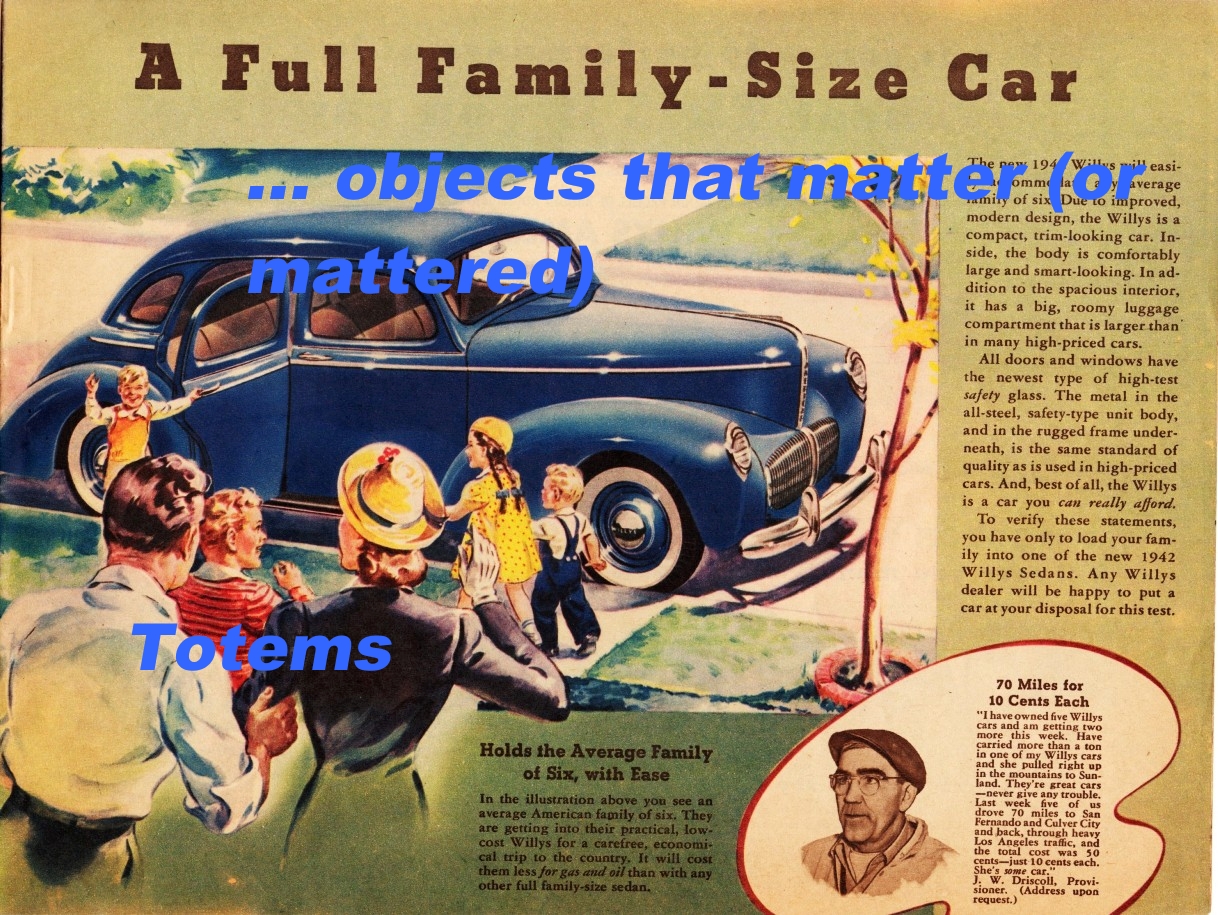
  5.            Totems – “Objects that Matter,” was really about car culture – something which apparently died (at least among potential audiences of Warp & Woof) more than twenty years ago. Beyond a planned piece on the decline and fall of General Motors, I’m not sure there is anything else in this realm that interests me enough to write about. If I were to write about EVs or autonomous vehicles, I could put it on The Future page, instead. Sigh.


If I seriously wanted to overcome my writer’s block, I think I would put more energy into writing on science and technology for The Future, and possibly launch a new page dedicated to political ideology (although I might keep covering elections and candidates in The Past). I used to be an information professional, so I ought to have a strong technology focus, right? But it may have been too long since I retired from that field. I could do some research, though! That might be fun.

If only I could recreate the feedback loop from that ACL Writers Group and Jerry. That would surely dissolve my writers block! But it would require collective reading and commenting, perhaps face-to-face in a classroom environment. This Spring, I had an unhappy experience with a Zoom writers’ class where nobody read anything, and all writing was limited to 250 words, only read aloud in a kind of “performance.” Not the experience I was seeking. Worse, I mistakenly chose Tara Reade and her accusation of sexual assault against Joe Biden as my topic – basing four short blurbs on that continuously breaking news cycle, with commentary about her reliability and “the truth.” It amounted to nothing, and my writing came across as shallow, given the constraining format of the class. Not my style.

Perhaps American politics, and media coverage of it, is too shallow? That alone could explain my writing doldrums lately. I need better subject matter!

Friday, June 12, 2020


How Long Can I Last?

Getting Used to the Pandemic

William Sundwick

We are gradually re-opening. Phase 2 has begun. Chances are good that I can soon get an appointment at my local Hair Cuttery. Heck, if I wanted to, I bet I could go to my gym again starting this weekend.

It’s been nearly three months of pandemic quarantine in Northern Virginia. Long enough for old routines to be replaced by new ones. Long enough for me to become quite familiar with grocery delivery services and literally everything else I need or want in my day-to-day life, all available with “contactless delivery.”

The new routines have become so comfortable, in fact, that I’m in no hurry to return to the Before Times. And, nobody in my life is encouraging me to jump back in. Kids and wife all urge caution. Perhaps my previous life was not so dependent on getting out, anyway. I’m more concerned with weight gains from gym withdrawal than any social deprivation; more concerned about my car battery dying from sitting in the driveway than from the absence of driving pleasure (despite having just bought a new car in September).

And, loneliness is not a problem since my wife works from home. I know not everyone’s life is so well-situated. I gather there are serious class divides, not to mention personality constraints, that determine how well people can cope with quarantine fatigue. As always, I must “check my privilege” here.

Some adaptations I’ve made in my admittedly favorable circumstances as a retired, high risk, 73-year-old man are these:

  •          Daily neighborhood walks are now enjoyed in company of my wife, after she goes “off the clock” late in the day – a new opportunity for some companionship. We’ve altered some of my standard routes on account of crowded trails or difficult topography. 
  •          Doing our own housecleaning has been required since maid service was suspended during the quarantine. I’m not very good at this, but doing some things occasionally feels like mastery.
  •          Discovery of grocery delivery services – Amazon Fresh, Instacart, Peapod, our favorite bakery. I had not been aware of this world previously but, indeed, you have always been able to get delivery of most things. It is contactless but I often leave an extra tip in an envelope taped to door. Delivery is getting easier now as more time slots are available. I try not to think about crossing picket lines for Amazon and Instacart drivers, who have been trying to strike.
  •          Podcast listening times have changed somewhat – no longer during neighborhood walks or gym workouts -- but quite compatible with my typical Internet cruising routine during my wife’s workday. I still cannot combine listening to a podcast with reading a book, however.
  •           One thing I do miss is my music library. That was previously reserved for listening while at the gym. I have not found another convenient time where my collection of rock, blues, and folk gives me the same biofeedback or physical/emotional charge as during gym workouts. Since I am not sure when I will return to the gym, I have some incentive to find another good music environment.
  •       Speaking of my gym, I have noticed weight up about five pounds over this quarantine period – vigorous exercise, mostly cardio with some back strengthening, apparently was also a weight control strategy. Yet, gyms are high-risk indoor environments and I still await guidance. Surely, I won’t return until Phase 2 is well-established (gyms only at 30 per cent capacity, with no backsliding in new cases). Investment in home exercise equipment remains a dubious endeavor. 


In addition to these adaptations, there have been some non-routine experiences. I learned to give myself a haircut (after a fashion); with extra begging, my wife does the back of my head. It looks reasonable! I have ventured out, occasionally, to the post office, pharmacy, or local hardware store. Post office and pharmacy were fine (masks required), but the hardware store with its narrow aisles and many customers was somewhat scarier. FaceTime has become the standard means of communication with the grandkids, and my two adult sons as well. Recently, the George Floyd/Black Lives Matter protests came to my neighborhood (finally), and I crafted a sign, walked to the protest site, and mingled with the masked crowd for an hour!


Perhaps the best part of the pandemic quarantine, however, has been deciding what to watch next on television! The entertainment ecosystem has blossomed in recent years – it’s little wonder that movie theaters, even without a pandemic, are having a hard time surviving these days. Subscriptions to streaming services (and cable still in my house!) provide a myriad of choices – quality choices, too! When the latest Hulu series is complete (right now, Little Fires Everywhere), there is yet another queued up in “My Stuff” – or maybe back to HBO for the final season of The Wire, or Netflix, or Prime Video (just finished The Romanoffs there). With such a panoply of late-night entertainment, including snacks and nightcaps, there is conceivably no limit to how long I can last!